

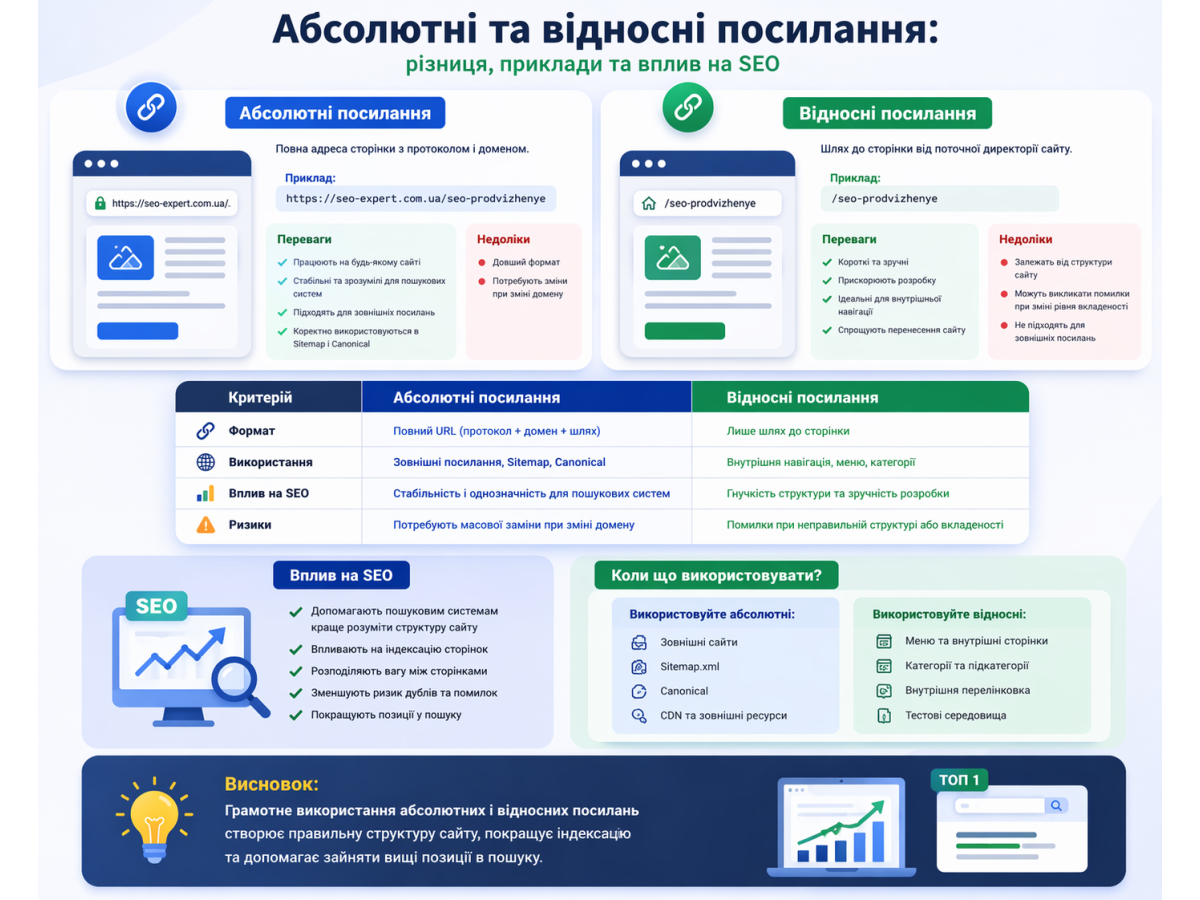
Absolute and relative links are a fundamental part of website structure, directly affecting indexing, page authority distribution, and overall SEO performance. Incorrect link usage can lead to duplicate pages, ranking losses, and technical issues.
For commercial websites and services, a properly structured linking system is not just a technical detail — it is a growth factor. Let’s break down how it works in practice.
What Are Absolute Links
An absolute link is a full URL that includes the protocol, domain, and path.
https://seo-expert.com.ua/en/seo-promotion-en
Such a link always points to a specific address regardless of where it is used.
Advantages
- stable across all environments;
- no errors during page migration;
- clear for search engines;
- suitable for external resources.
Disadvantages
- longer format;
- requires updates when changing domain.
What Are Relative Links
A relative link is a path to a page without the domain, used within the same website.
/en/seo-promotion-en
It depends on the current URL and site structure.
Advantages
- short and convenient;
- faster development process;
- ideal for internal linking;
- simplifies site migration.
Disadvantages
- depends on site structure;
- risk of path errors;
- not suitable for external use.
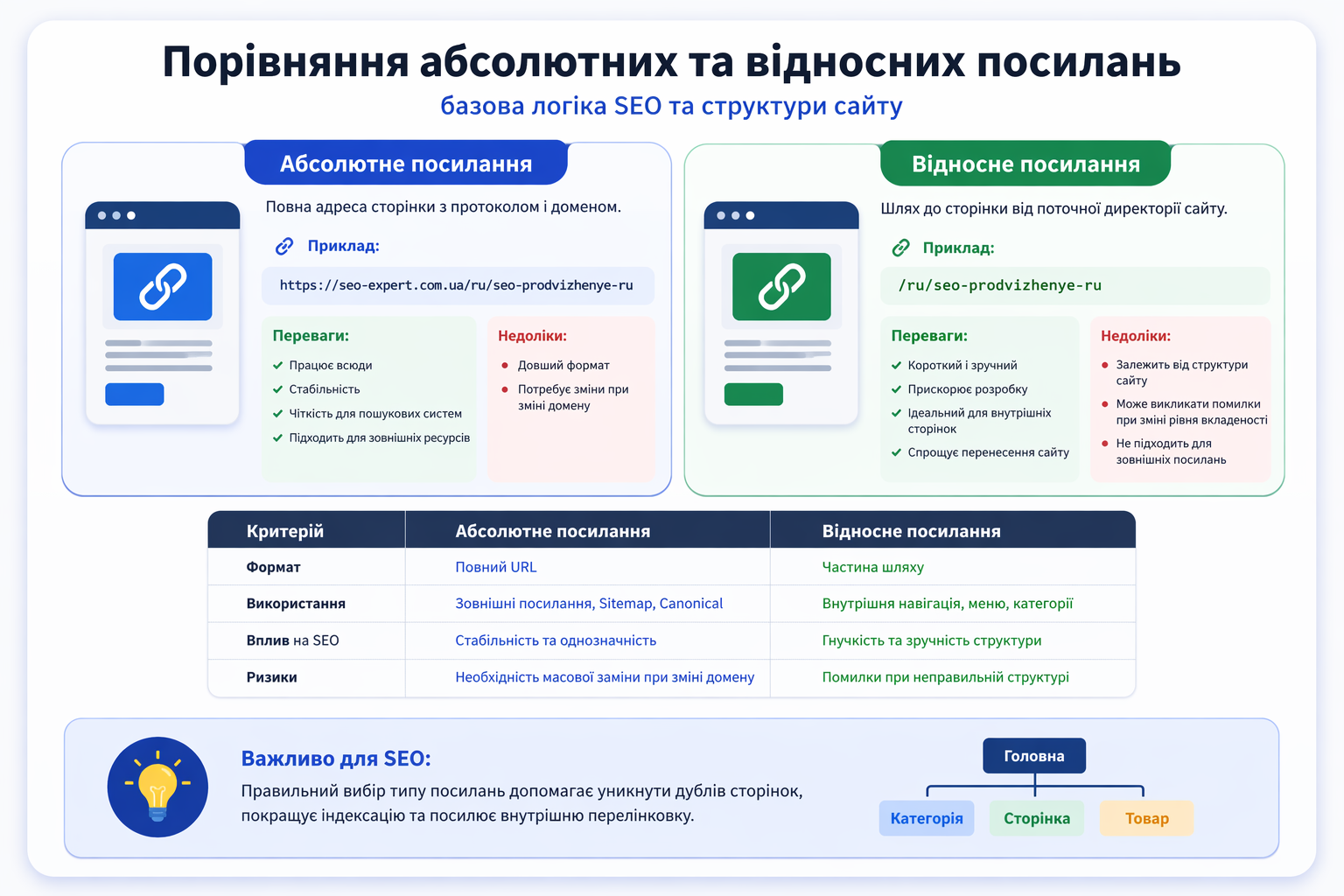
Comparison of absolute and relative links — the foundation of SEO and site structure
Key Differences
How Links Affect SEO
Search engines use links to understand website structure and determine page importance. Incorrect URL handling reduces SEO effectiveness.
- builds site architecture for crawlers;
- distributes link equity;
- affects indexing speed;
- defines page hierarchy.
If the same page is доступна via multiple URLs, it creates duplicates, which negatively impacts rankings.
When to Use Each Type of Link
Use Absolute Links
- external websites;
- sitemap.xml;
- canonical URLs;
- CDN and APIs.
Use Relative Links
- internal pages;
- navigation and menus;
- categories;
- staging environments.
What to Pay Attention To
- use a consistent link format;
- avoid duplicate pages;
- control internal linking;
- set canonical URLs;
- run regular SEO audits.
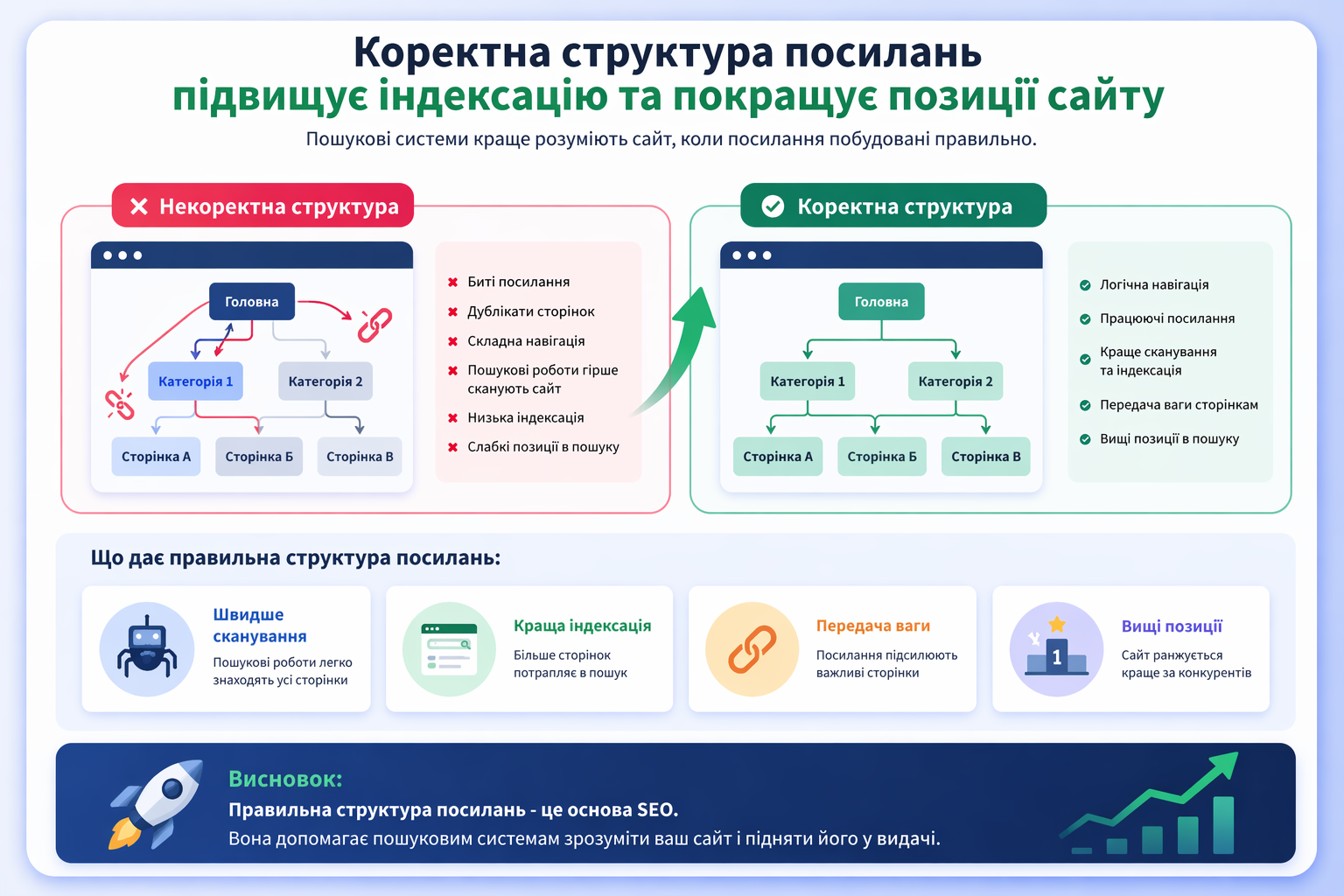
Proper link structure improves indexing and boosts search rankings
Practical Conclusion
Absolute and relative links are complementary tools. Their proper use creates a stable site structure and enhances SEO performance.
In practice, it is important not only to understand the difference but to implement a consistent linking strategy across the entire website.
This is a core part of SEO services that directly impacts indexing and ranking growth.
Learn more about the approach to optimization on the main page.
Need a consultation?
If you need help with SEO, website audit, or choosing the right promotion strategy, request a callback.
Request a callback